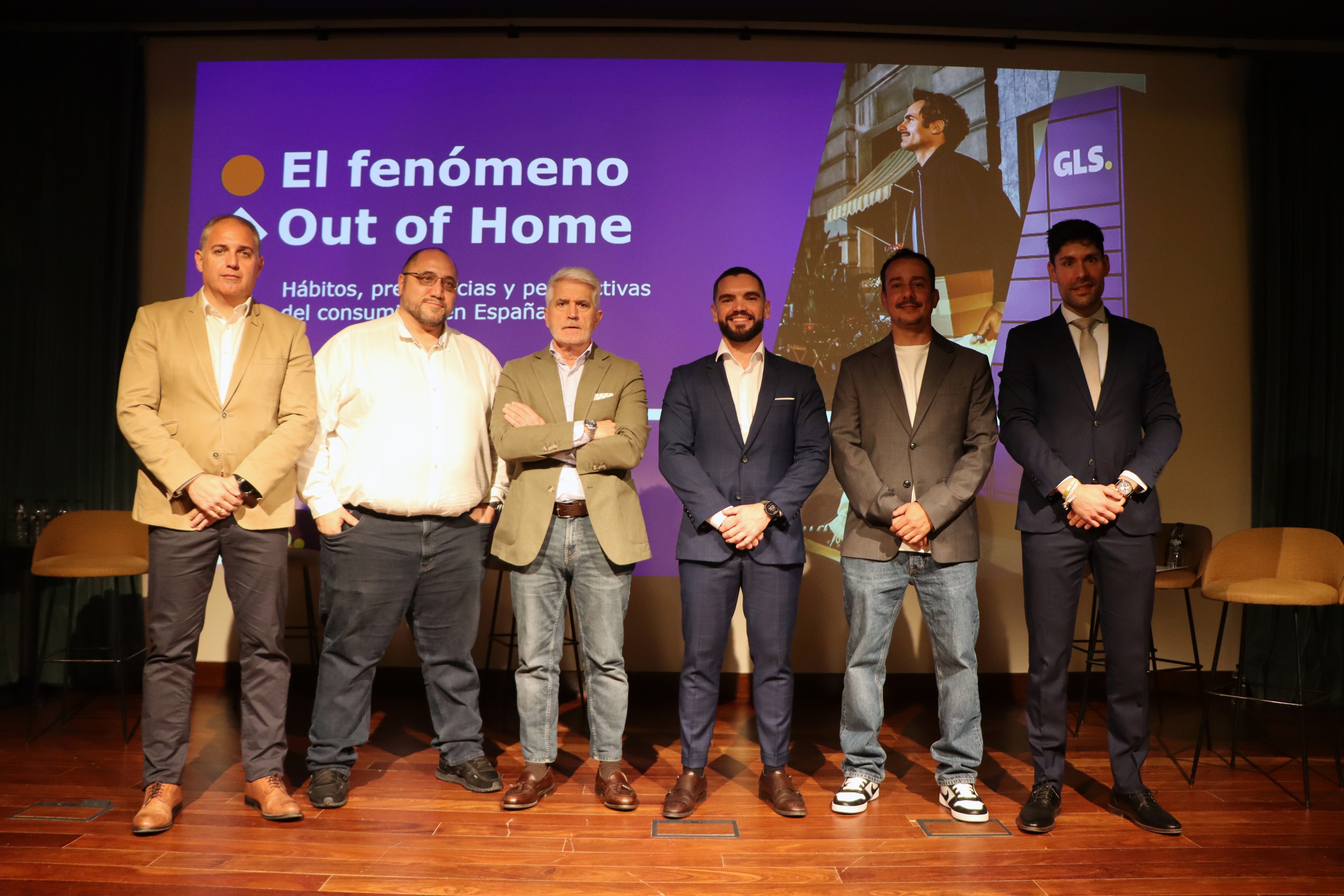
Madrid, March 12, 2026. GLS Spain held an event today at Espacio Monday in Madrid focused on the Out Of Home (OOH) model, which involves delivering and collecting orders at convenience points and parcel lockers, and its contribution to more efficient, flexible, and sustainable urban logistics. The event served to share the main conclusions of a GLS Spain study on consumer perception, consumption habits, and sector outlook regarding the OOH phenomenon, and to open a dialogue with experts about trends and challenges in last-mile delivery.
During the event, GLS presented data reflecting the direct impact of this model on the activity of local businesses. According to the study, 1 in 2 Spaniards (54%) say they have bought a product in the store when they go to collect a parcel, a behavior that helps stimulate the local economy.
In addition, 86% of Spanish consumers believe this model has a positive impact on local commerce, highlighting greater visibility for local businesses, increased sales, and higher foot traffic as some of its main advantages. These figures confirm that every parcel collection is also a commercial opportunity for neighborhood businesses.
The report also reveals that 64% of Spaniards who shop online have already used a convenience point or a smart locker, consolidating this collection model as a growing alternative to traditional home delivery. Within this modality, smart lockers already account for more than one third of Out Of Home delivery choices, reflecting the growing consumer preference for solutions that offer greater flexibility and autonomy when collecting orders.
Juan Sandes, Senior Manager Strategy, OOH and Fulfilment at GLS Spain, said during the presentation:
“Out Of Home is consolidating as a solution that brings value to the entire ecosystem: it offers flexibility to consumers, reduces failed deliveries, and helps local businesses gain traffic and sales opportunities. With this event, we want to share data and experiences to continue moving toward a more efficient and sustainable last mile.”
Roundtable: challenges and opportunities for the last mile in urban environments
Following the presentation of the study, a roundtable discussion addressed the main challenges of urban distribution: the evolution of consumer habits, the need to reduce failed delivery attempts and kilometers traveled, coexistence with commercial activity in neighborhoods and city centers, and the role of OOH networks as a lever to improve operational efficiency.
The panel included Rafael Aguilera, Managing Director of UNO, the Spanish Logistics and Transport Business Organization; Álvaro Martín Expósito, Operations Director at ICP; Fares Kameli, CIO of La Casa de las Carcasas; Ezequiel-Olmo Carretero Hernández, Manager of the GLS Las Rozas agency 818; and José Luis Ballesteros, OOH Manager at GLS Spain. All participants agreed on the importance of promoting delivery models that combine network reach, user experience, and sustainability, as well as close collaboration between operators, retailers, and local authorities. In this context, the Out Of Home model is clearly entering an adoption phase in Spain, consolidating itself as a key solution to improve last-mile efficiency in urban environments.
In this regard, Rafael Aguilera highlighted the potential of these solutions to improve urban freight distribution:
“The development of Out Of Home networks is one of the clearest levers to improve last-mile efficiency in cities. It allows deliveries to be consolidated, reduces failed attempts, and moves toward a more sustainable logistics model that is better integrated into the urban environment.”
From an operational perspective, Álvaro Martín Expósito emphasized the advantages this model brings to logistics management:
“Out Of Home allows routes to be optimized, deliveries to be consolidated, and kilometers traveled to be reduced. This not only improves distribution efficiency but also helps reduce delivery pressure in city centers.”
For his part, Fares Kameli highlighted how these solutions are helping better connect online and physical channels in retail:
“For retail, collecting online orders in stores or nearby points is an opportunity to better connect digital and physical channels. Many customers take advantage of the collection to make additional purchases, turning logistics into a driver of traffic and sales.”
Along the same lines, Ezequiel-Olmo Carretero Hernández emphasized the role of convenience points in energizing local commerce:
“Each collection generates real visits to neighborhood stores. For many establishments, being part of the Out Of Home network means attracting new customers and increasing the visibility of the business in their local environment.”
Meanwhile, José Luis Ballesteros highlighted the evolution this model is experiencing in Spain and the growth in the use of smart lockers:
“The Out Of Home model is clearly entering an adoption phase. In fact, within this modality, lockers already represent more than a third of delivery choices, which shows that consumers increasingly value flexibility and autonomy when collecting their orders.”
The full study is available for download at the following link: https://cloud.comunicaciones.gls-spain.com/out-of-home
About GLS Spain
GLS Spain is a subsidiary of the GLS Group, a leading provider of national and international parcel delivery, freight transport, and express shipping services with a presence in more than 50 countries. Thanks to its extensive logistics network and deep knowledge of local markets, GLS connects its customers with millions of daily shipments through high-quality, personalized, and flexible services across Europe, Asia, and the Americas.
As a group, GLS delivered 926 million parcels in the 2024–2025 fiscal year, thanks to its structure of more than 1,700 facilities, a fleet of over 42,000 trucks and delivery vehicles, and an Out-of-Home network of more than 117,000 parcel delivery and collection points.
In Spain, the GLS network includes more than 600 centers and agencies, supported by over 10,000 GLS Points (convenience points and smart lockers) and more than 4,900 delivery vehicles and walkers.
The KM0 Hub in Madrid, with a surface area of more than 33,000 m², is the main logistics center and headquarters of GLS Spain. It features advanced logistics technology, including automated sorting systems capable of processing up to 50,000 parcels per hour, allowing operational flows of more than one million shipments per day during peak periods.
GLS operates three Artificial Intelligence Hubs in Europe, each specialized in a key business area. The CX & Sales AI Hub in Spain is the driving force behind the digital transformation of customer experience, marketing, and sales across the Group.
For more information, visit: